The Three Pillars of Effective Contamination Control
Effective contamination control consists of three major components:
- Understanding contamination sources
- Controlling and removing contamination
- Maintaining systems that function correctly at all times
A successful program requires multiple interrelated processes operating consistently and cohesively.
Understanding Particles and How They Behave
A core theme of the webinar is particle behavior.
Essential considerations for designing effective removal strategies:
- How particles move
- How they adhere to surfaces
- How environmental conditions influence them
Particle behavior informs the choice of cleaning tools, techniques, and frequency.
Sources of Contamination in Cleanroom Environments
Contamination sources include:
- Personnel
- Equipment
- Surfaces
- Airflow
- Production activities
Every element of the environment can contribute to contamination if not properly controlled.
Effective programs must identify contamination sources and address them systematically.
The Interconnected Nature of Control Systems
Contamination control is not isolated to a single activity.
Contamination control involves:
- Environmental monitoring
- Cleaning and disinfection
- Facility design
- HVAC systems
- Personnel practices
- Production operations
Each system must function properly at all times to achieve the desired quality outcome.
Failure in one area can compromise the entire program.
Surface Cleaning and Particle Removal Principles
Surface cleaning is a critical mechanism for removing particulate contamination.
Key principles include:
- Efficient removal rather than redistribution
- Proper wiping techniques
- Use of appropriate materials
- Understanding surface compatibility
Cleaning must be designed to physically capture and remove particles, not simply move them.
The Role of Mechanical Action in Cleaning
Mechanical action is emphasized as essential for effective contamination removal.
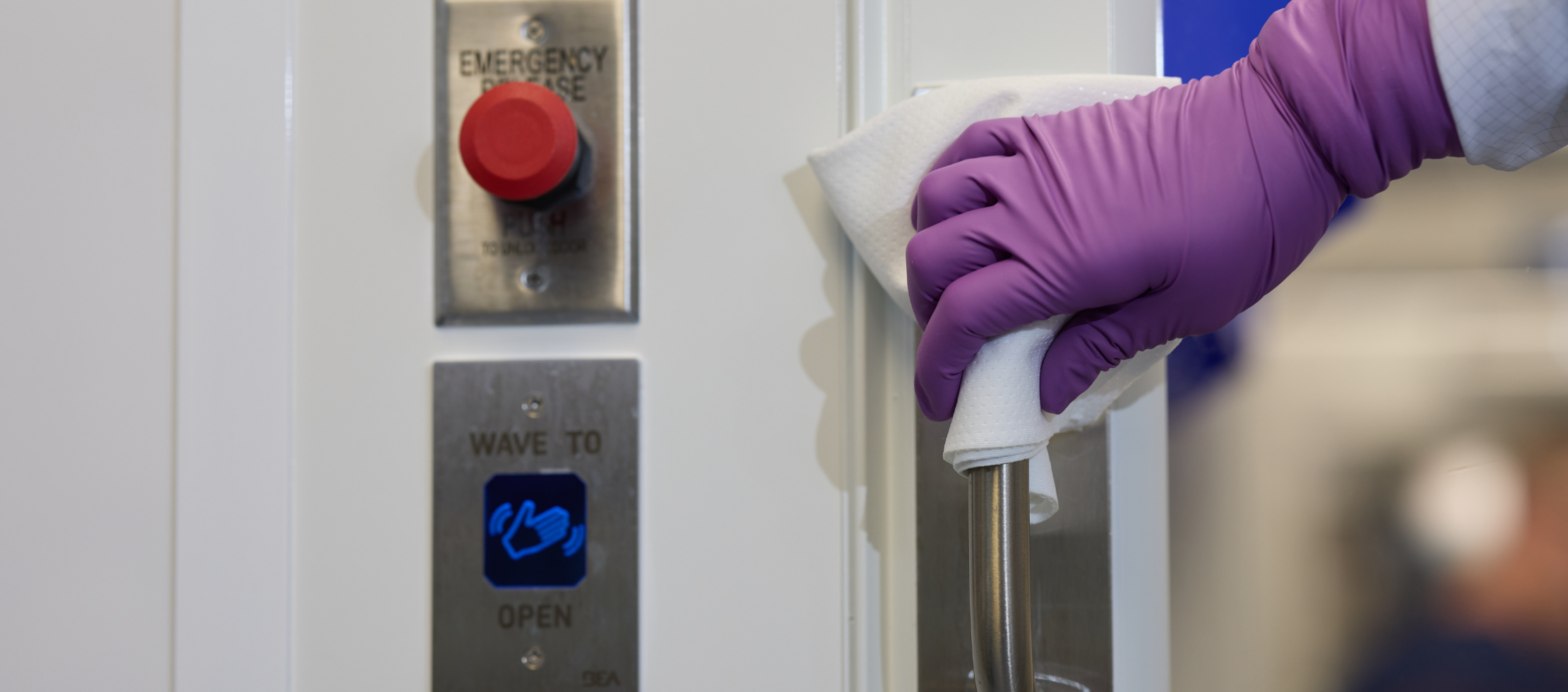
Disinfectants alone do not remove particles; physical wiping action:
- Dislodges contaminants
- Captures particles
- Prevents redeposition
The choice of wipes, tools, and technique directly influences cleaning performance.
Cleaning as a Process Component—Not a Support Function
A critical message of the webinar is that contamination control should be treated as part of the manufacturing process itself.
Just as production equipment is validated and maintained, contamination control processes must be:
- Defined
- Controlled
- Monitored
- Continuously improved
Cleaning is not housekeeping—it is process control.
Aligning Contamination Control with Product Quality
Product quality is the ultimate output of effective contamination control.
An effective contamination control program ensures:
- Consistent environmental conditions
- Reduced particulate risk
- Reduced microbial risk
- Reliable process performance
Contamination control must be integrated into the overall quality system to ensure optimal results.
 Contec Cleanroom
 Microelectronics, Biotechnology, Medical Devices, Pharmaceutical, Contamination Control, Webinar



 return to overview
 back to top